
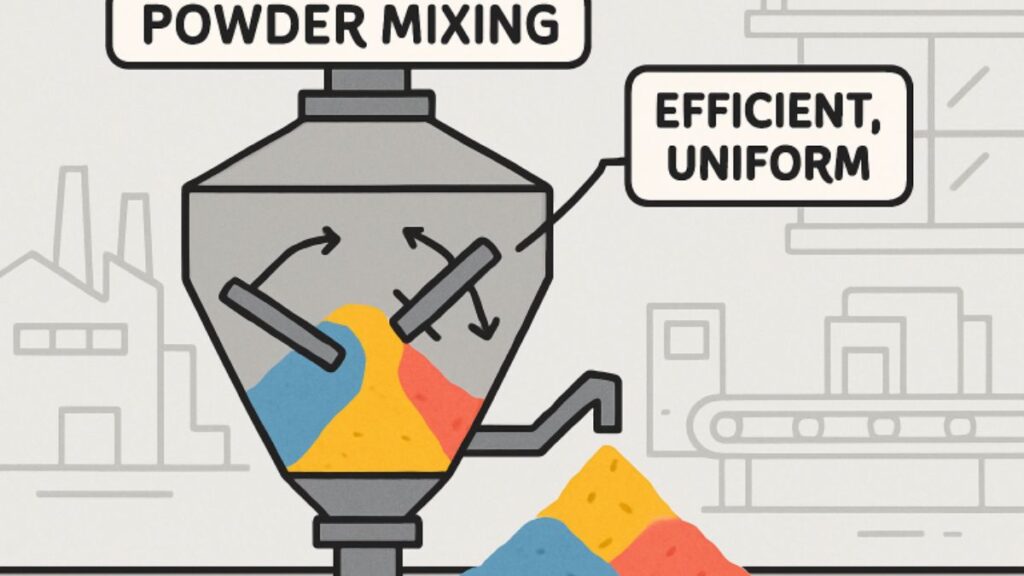
Powder mixing is a foundational requirement across many industries, including pharmaceuticals, food production, and chemical processing. Achieving efficient and uniform mixing is essential not only for maintaining product quality but also for ensuring consistency and safety throughout production lines. Innovations in technology have driven significant advancements in powder mixing, including improved equipment, enhanced process monitoring, and advanced control systems. For example, incorporating modern solutions, such as a fluidizer mixer, helps manufacturers achieve faster, more reliable results while optimizing operational efficiency.
The efficiency of industrial powder mixing now depends on integrating cutting-edge methods that reduce manual intervention, limit product loss, and allow companies to meet ever-tightening regulatory standards. Companies are continually exploring ways to use data, specialized equipment, and automation to ensure all powdered ingredients blend evenly, regardless of scale or material attributes.
Many challenges remain, such as accommodating diverse powders and blends, and the constant demand for higher throughput. Newer designs and intelligent software allow real-time adjustments during mixing. The shift to digitization and smarter systems demonstrates industry innovation. These advancements reduce energy costs and improve traceability, boosting sustainability and accountability. Companies adopting these strategies are more likely to stay competitive and compliant in a changing market.
Advancements in Powder Mixing Technologies
Recent breakthroughs in mixing have significantly altered how manufacturers approach powder blending. Technologies like the Silverson Flashmix enable powders to blend seamlessly into liquids, producing consistent results even at high throughput rates. Such innovations create a smoother workflow, minimize quality deviations, and expand the range of products manufacturers can deliver. Facilities that once struggled with powder agglomerates or uneven mixes now enjoy shorter processing times and greater uniformity.
Continuous improvement in equipment enables industrial processes to handle a wider range of powder viscosities and temperatures without sacrificing speed. These developments have opened the possibility of using more complex powder ingredients in formulations, reducing both labor time and product waste.
AI and Digital Twin Technologies in Mixing Processes
Artificial intelligence and digital twins are bringing a new dimension to powder mixing. By employing machine learning algorithms, companies can simulate mixing behaviors and predict blend outcomes before conducting actual trials. For example, research conducted by Osaka Metropolitan University demonstrated that AI-enabled models could simulate powder mixing up to 300 times faster than traditional methods. This progress leads to faster product development cycles and more efficient troubleshooting.
Digital twin technology not only enhances precision but also helps operators manage scale-up scenarios, investigate process bottlenecks, and predict optimal batch times. Manufacturers adopting these tools gain deeper visibility into the mixing process, enabling real-time monitoring and maintenance planning.
Innovative Equipment Designs for Enhanced Mixing
Equipment design plays a pivotal role in achieving the highest levels of mixing efficiency. Adjustments in mixer geometry, such as optimizing inlet angles or integrating active flow-aid components, can greatly influence the mixing process. For example, mixers with modified inlet designs ensure more consistent movement of poorly flowing powders, thereby significantly reducing friction, downtime, and material buildup.
Additional enhancements provide instantaneous air pulses that dislodge stagnant powder and maintain consistent flow. This reduces the chances of product segregation and batch inconsistencies, especially in large-scale or continuous operations.
Case Study: Optimizing Blending Operations
One global manufacturing company faced persistent issues with inconsistent product blends and long changeover times in its large bin blending systems. By implementing a digital twin platform, the operation was able to simulate complex powder behaviors, explore alternate design scenarios, and fine-tune process parameters in a virtual environment. The implementation resulted in substantial time savings and reduced material losses, paving the way for greater process reliability and scalability. Digital twins are gaining attention for their role in reducing manufacturing inefficiencies and supporting continuous improvement initiatives, as observed across the industry.
Future Trends in Powder Mixing
The future of industrial powder mixing leans heavily on smart technologies. Advanced data analytics, machine learning, and automation will enhance the ability to achieve homogeneous blends with minimal manual oversight. This will be especially important as demand grows for transparency, traceability, and real-time quality assurance in supply chains.
Equipment designs are projected to become even more flexible, with features accommodating a broader spectrum of powder properties and integration points for inline monitoring sensors. Manufacturers who adopt these solutions early can expect lower operational costs, improved regulatory compliance, and a strategic edge in their markets.
Conclusion
Powder-mixing innovation is rapidly transforming industrial processes, driving faster processing cycles, improved blend consistency, and significant energy savings. By adopting advanced equipment designs, digital technologies, and process automation, manufacturers across multiple sectors are not only keeping pace with change but setting new benchmarks in performance and product quality.